On 7 and 10 April 2026, ESSCA’s Paris campus hosted two full-day, hands-on workshops dedicated to the use of AI tools in social science research.
The sessions were organised as part of the Symposium on Behavioral AI in Education, Work, and Decision-Making within the EUonAIR university alliance and co-funded by the European Union.
ESSCA researchers spent two intensive days working directly on their own research challenges, exploring how AI can be integrated into real research workflows.
A shared frustration quickly emerged: most existing guidance on 'AI for research' is limited to conversational chatbots, which are useful for some tasks, but insufficient for rigorous academic work. The workshops deliberately moved beyond this approach.
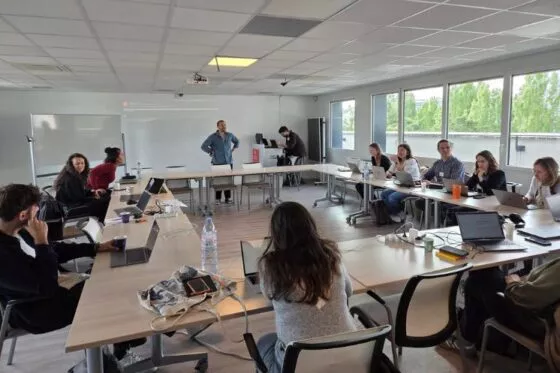
Understanding the foundations of AI‑assisted research
On the first day, Maksim Zubok (University of Oxford, Politics) led a session focusing on methodological foundations.
Participants examined how language models function and the influence of instruction formulation on outputs.
They also learned that prompts should be treated with the same methodological care as survey questions. In the afternoon, participants moved on to practical work, building systems that enable AI tools to reason over their own documents rather than relying solely on pre-trained data.
From methods to workflows
On the second day, the focus shifted towards a more workflow-oriented approach under the guidance of Rubén Fernández-Fuertes (Bocconi University, Finance).
Participants translated research tasks into plain English instructions for processing document collections, cleaning datasets and cross-checking results, and observed how AI agents could execute these tasks without the need for programming skills.
Practical outcomes and lasting impact
A key strength of the workshops was their practical focus. By the end of the two days, participants had configured working setups on their own laptops and developed a clearer understanding of the areas in which AI tools can provide reliable support and where human verification remains essential.
The interdisciplinary environment at ESSCA encouraged open discussion, critical questioning and cross-disciplinary exchange, ensuring the workshops were both technically productive and intellectually engaging. This experience emphasised the importance of creating environments where researchers can transition from experimenting with AI to working with it in a meaningful way.
This is an initiative well worth repeating.

Find out more
 10/06/2026
2026 AI Barometer: businesses accelerate AI adoption, but governance needs to keep pace
Artificial intelligence is now firmly established within European businesses. However, governance rules and practices, as well as awareness of the regulatory framework, are developing at a slower pace than AI adoption itself.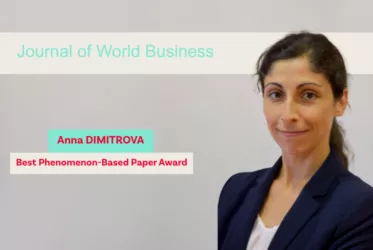 09/07/2026
Anna Dimitrova receives Best Phenomenon-Based Paper Award from Journal of World Business
Awarded by the Journal of World Business's editorial board, one of the leading authorities in international business, this distinction recognises research that combines methodological rigour, strong theoretical foundations and high relevance for contemporary organisations.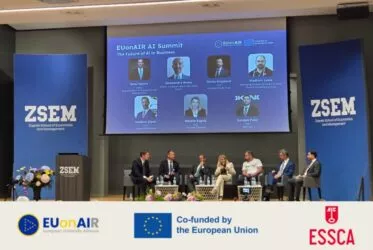 07/15/2026
Annual conference of the EUonAIR European University Alliance Consortium
ESSCA took part in the annual conference of the EUonAIR European University Alliance Consortium in Zagreb on 6–7 July 2026, a key event dedicated to the challenges of artificial intelligence in higher education, research and innovation.