Beyond the individual talks, what stood out most was the collective spirit of exchange: sharing approaches, discussing challenges, raising awareness, and learning across institutions about how AI can be integrated in ways that are responsible, practical, and sustainable.

Symposium on Behavioral AI in Education, Work, and Decision-Making
On April 8 and 9, 2026, ESSCA hosted the Symposium on Behavioral AI in Education, Work, and Decision-Making, bringing together researchers, practitioners, and institutional stakeholders from across Europe.
Over two days, keynote talks and workshops created a space for dialogue on the conditions necessary for the development of responsible, human-centered artificial intelligence in the service of higher education and the world of work.
A space for knowledge sharing, awareness raising, and dialogue across institutions and stakeholder groups
the Symposium on Behavioral AI in Education, Work, and Decision-Making brought together researchers, practitioners, educators, and institutional stakeholders from across Europe to engage with some of the most pressing questions of our time:
- What happens to learning and work when AI enters the room?
- Who stays in control?
- And how do we build institutions and practices that remain both human-centred and socially responsible?
Organised as part of the EUonAIR Alliance, co-funded by the European Union, the event was designed not only as an academic gathering, but also as a space for knowledge sharing, awareness raising, and dialogue across institutions and stakeholder groups.
Keeping it free and accessible to participants was an important part of that mission.
In that sense, the symposium and workshops contributed directly to EUonAIR’s wider goals: sharing methods for thinking about AI-related challenges in higher education, exchanging emerging practices around virtual and AI-enabled campus initiatives, and widening the circulation of project outputs and best practices across the EUonAIR network and beyond.
A few highlights from the keynotes
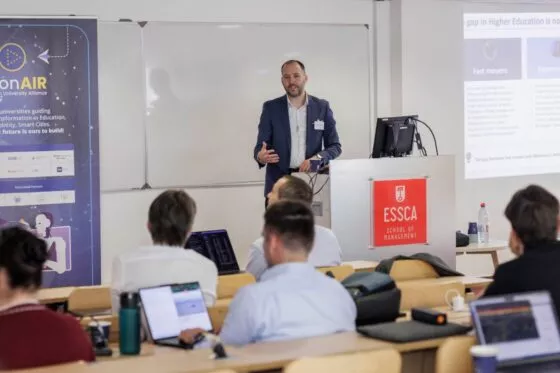
Thomas Coustenoble (Microsoft France & ESSCA Alumni) highlighted the widening gap between institutions actively integrating AI and those still observing from the sidelines.
His message was clear: this is not only a technology issue, but also one of culture, strategy, and leadership. His call to move from isolated tools to more agentic workflows, while keeping humans firmly in the loop, set the tone for the discussions that followed.
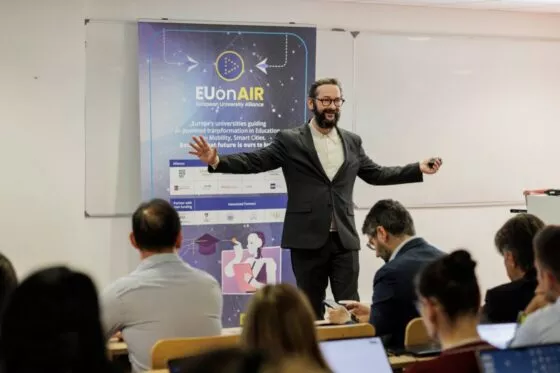
Jean-François Bonnefon (Toulouse School of Economics) shared compelling evidence that when people delegate decisions to AI, they often ask it to act in ways they would not themselves. Interface design, framing, and language all shape outcomes.
His talk was a powerful reminder that responsible AI is as much a behavioural and institutional challenge as it is a technical one.
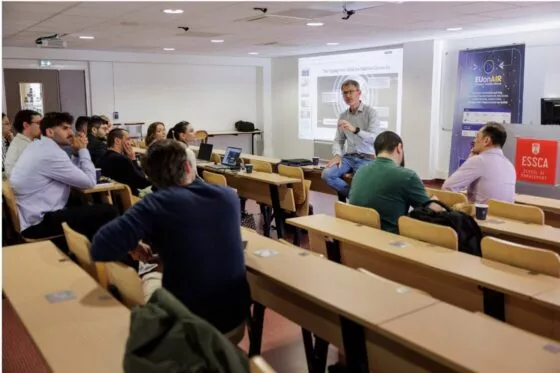
Erwan Paitel (French Ministry of Education) offered a grounded perspective on AI in education.
Moving beyond both hype and fear, he focused on what it takes to build governance and pedagogical frameworks that serve teachers, students, and institutions over the long term.
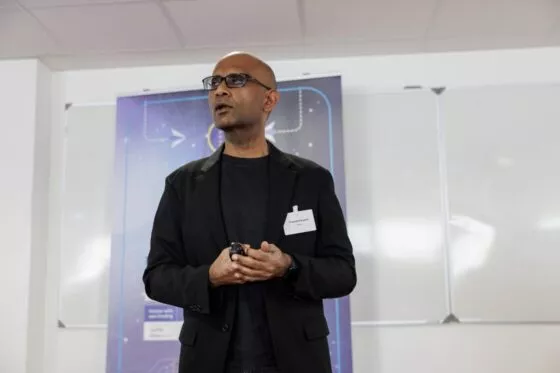
Phanish Puranam (INSEAD) invited us to rethink how humans and machines collaborate.
His reflections on ensembling, AI as tutor rather than just tool, and the effects of automation on meaning and purpose sparked some of the most nuanced conversations of the event.

Find out more
 10/06/2026
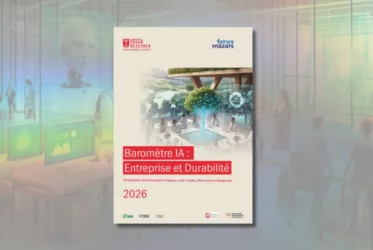
2026 AI Barometer: businesses accelerate AI adoption, but governance needs to keep pace
Artificial intelligence is now firmly established within European businesses. However, governance rules and practices, as well as awareness of the regulatory framework, are developing at a slower pace than AI adoption itself.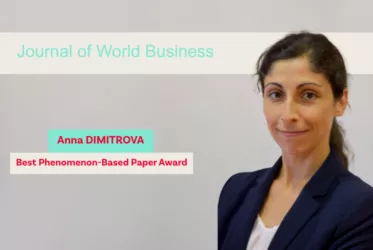 09/07/2026
Anna Dimitrova receives Best Phenomenon-Based Paper Award from Journal of World Business
Awarded by the Journal of World Business's editorial board, one of the leading authorities in international business, this distinction recognises research that combines methodological rigour, strong theoretical foundations and high relevance for contemporary organisations.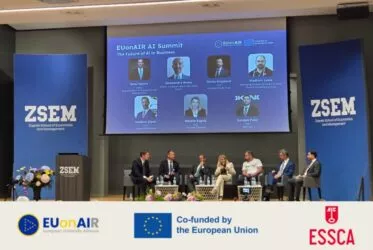 07/15/2026
Annual conference of the EUonAIR European University Alliance Consortium
ESSCA took part in the annual conference of the EUonAIR European University Alliance Consortium in Zagreb on 6–7 July 2026, a key event dedicated to the challenges of artificial intelligence in higher education, research and innovation.