Hungary has become one of Europe's best-kept secrets for international students. With over 28,000 international students, more than 500 English-taught programmes and living costs among the lowest in the European Union, it delivers a European degree and a European experience at a fraction of the usual price.
Key takeaways
- Hungary combines living costs of €500 to €900 per month, established universities and a central European location that makes travel across the continent straightforward.
- Budapest concentrates most of the international offer, with numerous multinational companies creating internship opportunities alongside a vibrant student and cultural life.
👉 In practice, Hungary offers one of the strongest cost-to-experience ratios in Europe, particularly for students who want a genuinely international environment without a Western European budget.
Why study in Hungary
Hungary's appeal rests on a straightforward proposition: European academic standards at Central European prices.
- Genuinely low living costs. Students typically spend €500 to €900 per month in Budapest, and less in smaller cities. University dormitories start as low as €80 to €150 per month, among the cheapest student accommodation in the EU.
- A large English-taught offer. Hungarian institutions deliver more than 500 English-taught programmes across business, science, medicine and the arts. Studying entirely in English is straightforward.
- A long academic tradition. Hungary's oldest university dates back to 1367, and the country has invested significantly in higher education over recent decades.

- Budapest as an international business hub. The capital hosts numerous multinational companies, including shared service centres and regional headquarters, which creates real internship and graduate opportunities for business students.
- Substantial scholarship provision. The Stipendium Hungaricum programme covers tuition and provides a stipend, alongside the Hungarian Diaspora Scholarship and university-specific merit awards.
- A central European base. Hungary's position makes short trips to Vienna, Prague, Bratislava and beyond easy and inexpensive, which matters when you want to make the most of a European year.
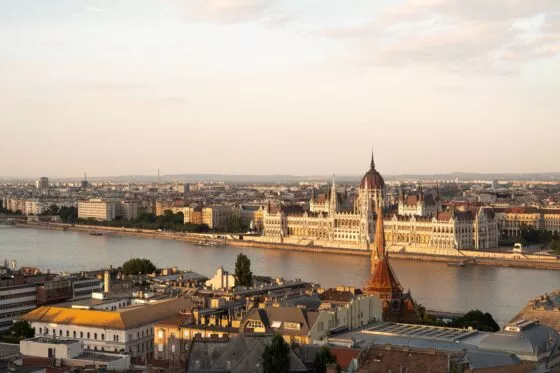
- A city worth living in. Budapest combines UNESCO World Heritage sites, the Danube, thermal baths, broad avenues and a mix of architectural styles that few European capitals can match.
Studying in Hungary at a glance
| Criterion | What to expect |
| International students | Over 28,000 |
| English-taught programmes | More than 500 |
| Living costs | €500 to €900 per month |
| University dormitory | €80 to €150 per month |
| Private flat (Budapest) | €400 to €600 per month |
| Work rights (non-EU) | Up to 24 to 30 hours per week during term |
| Key scholarship | Stipendium Hungaricum |
What you need to know before you go
Budgeting
Living costs are the main attraction. Most students spend €500 to €800 per month in Budapest, with other Hungarian cities noticeably cheaper.
Accommodation drives the difference. University dormitories are by far the most economical option at €80 to €150 per month, and they also make it considerably easier to build a social circle quickly. Private rooms in shared flats start around €200, while a private flat in Budapest runs €400 to €600.
One practical warning: Budapest landlords typically require two months' deposit plus the first month upfront, which can mean €1,000 to €1,500 payable before you move in. Budget for this separately, as it catches many students out.
Visa and requirements
Non-EU students need proof of admission, proof of funds, health insurance and proof of accommodation. Visa fees are modest by international standards. Requirements are updated regularly, so verify current figures with the Hungarian authorities before applying.
Working while studying
Non-EU students holding a student residence permit may work up to 24 to 30 hours per week during term and full-time during holidays, within defined limits. EU students face no restrictions.
A realistic note: the Hungarian minimum wage sits around €820 per month gross, so part-time work is best treated as covering rent or personal spending rather than funding tuition. Student-friendly jobs in hospitality, English tutoring, IT and customer service are readily available in Budapest.
Do track your hours carefully. Exceeding the permitted limits can jeopardise your residence status.
Language
You do not need Hungarian to study, and English is widely spoken in Budapest's international and business circles. Learning some basics helps considerably in daily life, and most institutions offer Hungarian language and culture courses that are worth taking for the cultural insight alone.

Studying in Hungary with ESSCA
ESSCA's presence in Budapest is not recent. The school arrived in 1993, at the invitation of Corvinus University, one of Central Europe's leading economics institutions, to co-create a joint bachelor's programme. More than thirty years later, the Budapest campus has developed its own identity.
ESSCA in Budapest is the only French business school in Hungary delivering a degree recognised by the French Ministry of Higher Education and Research and accredited by the Conférence des Grandes Écoles. All courses are taught in English.
The campus sits in the heart of Budapest on the Pest side, close to Corvinus University, with metro, tram and bus connections, shops, restaurants and cafés on the doorstep. It is a deliberately small and intimate setting, which translates into close interaction with teaching staff, while remaining connected to a much larger student community nearby.
The main offer is the Bachelor in International Management, focused on international management and strategy. The campus also hosts the Master in Management and welcomes students from across the ESSCA network and from partner universities worldwide, through semester programmes including the Budapest Specialisation Semester and the Central and Eastern European Business Semester.
Admission is open to both French and international students. French qualification holders apply via Parcoursup, while international diploma holders apply through the international admissions route.
Going further
Hungary rewards students who look beyond the obvious destinations. If you want a European degree, an international cohort and a manageable budget, it deserves serious consideration. Most institutions run online information sessions for international applicants, which is the quickest way to clarify admission requirements and costs.
FAQ
Is Budapest a good city for business students?
Yes. The capital hosts numerous multinational companies, including regional headquarters and shared service centres, creating genuine internship and graduate opportunities. Combined with low living costs and a strong cultural life, it offers an unusual balance for international students.
Can I work while studying in Hungary?
Non-EU students may work up to 24 to 30 hours per week during term and full-time during holidays, within limits. EU students face no restriction. Given the local wage level, treat part-time work as covering living costs rather than tuition, and track your hours carefully to protect your residence status.
How much does it cost to study in Hungary?
Living costs run €500 to €900 per month, with Budapest at the higher end. Dormitories cost €80 to €150 monthly, private flats €400 to €600. Tuition varies widely by institution and programme. Remember to budget separately for the deposit, typically two months' rent plus the first month.
Can I study in Hungary in English?
Yes. Hungary offers more than 500 English-taught programmes, and some institutions, including ESSCA in Budapest, teach entirely in English. Hungarian is not required to study or to work in international companies in Budapest.