Artificial intelligence is now firmly established within European businesses. However, governance rules and practices, as well as awareness of the regulatory framework, are developing at a slower pace than AI adoption itself.
In partnership with Forvis Mazars, ESSCA’s AI for Sustainability Institute has published the second edition of its AI, Business and Sustainability Barometer
Conducted in March 2026 among 826 IT and digital professionals in France, the United Kingdom, Germany and Spain, the study examines how artificial intelligence is being integrated into organisations and its impact on sustainability. It builds on the indicators established in 2024 and explores four topics that have become increasingly important: autonomous AI agents, Shadow AI, AI-assisted coding and digital sovereignty.
AI has moved beyond experimentation as adoption becomes widespread
The findings confirm that AI has moved beyond the experimental stage. Nearly two-thirds of businesses now have a dedicated team responsible for overseeing AI, while 57% provide AI training for their employees. This momentum is expected to continue, with 58% of respondents planning to increase investment in AI. However, investment remains largely defensive in nature, with the fear of falling behind still cited as the main reason for investing.
At the same time, AI use is becoming both more widespread and more diverse. Language models are used for everyday office tasks in 80% of the businesses surveyed and for internal information searches in 60%. Autonomous AI agents are also moving into production, with 35% of organisations already using them, including 7% that report extensive use.
However, this rapid adoption raises a major governance challenge. Two-thirds of respondents report Shadow AI practices, meaning employees are using AI tools without oversight from their organisation. Yet fewer than half of organisations have established formal ethical guidelines, and only 28% of the professionals surveyed believe their organisation has a good understanding of the EU AI Act.
Finally, while 61% of respondents believe that AI has a positive impact on sustainable development within their organisation, its environmental footprint is still rarely measured. Only 30% of organisations monitor the energy consumption associated with AI, while 25% assess its net greenhouse gas emissions.
This second edition highlights the need for businesses to move beyond simply trying to keep pace with technological developments and instead build an AI strategy based on clearly identified needs, the value it creates and a responsible framework for its use.
Find out more
 09/07/2026
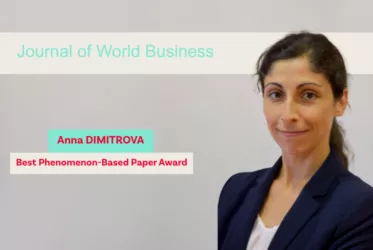
Anna Dimitrova receives Best Phenomenon-Based Paper Award from Journal of World Business
Awarded by the Journal of World Business's editorial board, one of the leading authorities in international business, this distinction recognises research that combines methodological rigour, strong theoretical foundations and high relevance for contemporary organisations.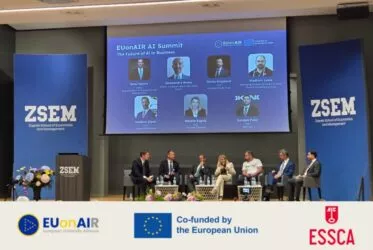 07/15/2026
Annual conference of the EUonAIR European University Alliance Consortium
ESSCA took part in the annual conference of the EUonAIR European University Alliance Consortium in Zagreb on 6–7 July 2026, a key event dedicated to the challenges of artificial intelligence in higher education, research and innovation. 07/15/2026
ESSCA strengthens its international reach in sustainable AI
Through its AI for Sustainability Institute, ESSCA is pleased to announce the signing of a scientific partnership with AITAI (Australian Institute of Transformation and AI) at St Catherine’s College, Perth.