Pedagogical Innovations

An Institute of Advanced Pedagogy (IPA) established in 2010
The IPA is ESSCA’s educational centre. It is dedicated to supporting the professional development of our faculty by offering training, workshops, personalised advice, and spaces to innovate and improve teaching practices.
The IPA also oversees the Assurance of Learning (AoL) approach, which is defined in collaboration with our accreditation bodies and coordinates the student course evaluation, a formative approach to enhance and improve teaching practices within our institution.
At the IPA, the complementarity of professional roles and profiles allows for comprehensive support, with the clear objective of supporting teaching in order to improve learning.
Faculty training and support
On a day-to-day basis, the IPA provides training and both individual and collective support for teaching staff on a wide range of projects.
The IPA fields of expertise spans all stages of course design, with a focus on creating techno-pedagogical environments that are conducive to teaching and learning.
For example, as part of the redesign of the Grande École programme from 2019 to 2023, the IPA played a crucial role in supporting professors. Various tools and approaches were used, including a course design handbook incorporating key concepts and frameworks for pedagogical scripting adapted to the context.
Higher education pedagogy
A multitude of tools, methods, and approaches from the literature on higher education pedagogy are employed in a ESSCA’s internally designed training programmes for professors.
More than twenty different training courses are offered. These are dedicated to various aspects of teaching design, such as “Teaching an adult audience”, “Identifying pedagogical objectives”, and “Assessing learning”. They also cover the creation of educational resources, including the design of serious games and the integration and deployment of digital tools.
Digitalisation of teaching
In the area of teaching digitalisation, ESSCA provides comprehensive support to professors by collaboratively analysing their needs and the requirements of their teaching systems.
The IPA’s expertise spans several aspects, including the technical facets of resource design and production, ergonomics, and accessibility. Guidance is also provided on the selection of digital tools—such as learning management systems (LMS), artificial intelligence solutions and complementary applications—based on their potential and relevance to the projects at hand.
Consideration is also given to factors such as learner engagement, motivation and success. For instance, the IPA has contributed to the development of several MOOCs focused on innovative topics. These include the Periscope project on purchasing and supply management, and the FIRE and subsequent FIRE+ MOOCs on integrating refugees through sports.
Supporting and promoting teaching initiatives
Since 2019, the IPA has set up a Pedagogical Initiatives Fund (FIP) to support the improvement of teaching and learning practices.
Each year, professors are invited to submit projects to a selection committee composedof international specialists in higher education pedagogy from renowned institutions (McGill University, Polytechnique Lausanne, Polytechnique Montréal, University of Montreal…).
Projects are evaluated on the bases of various criteria, including the analysis of the challenges faced by the professor and/or students, the planned evaluation, transferability, and management of the project. As a result, numerous successful initiatives, such as gamified applications, the development of learning spaces, and programmes focusing on the personal and professional development of learners, have been successfully implemented, supported by dedicated human and financial resources.
Examples of projects supported by the Pedagogical Initiatives Fund (FIP)

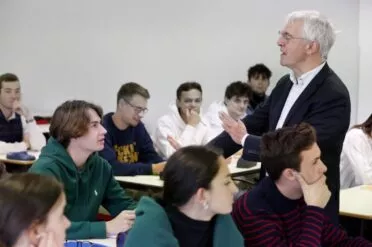


Stéphane Justeau
All these initiatives enrich the expertise of ESSCA's professors and also enable us to promote our practices beyond our campuses and borders.
A teaching community of practice and support for professors in promoting their practices (symposiums, articles, etc.) support these objectives by encouraging discussion, sharing and the formalisation of teaching practices.